
Movies of vascular development from the Bautch Lab:

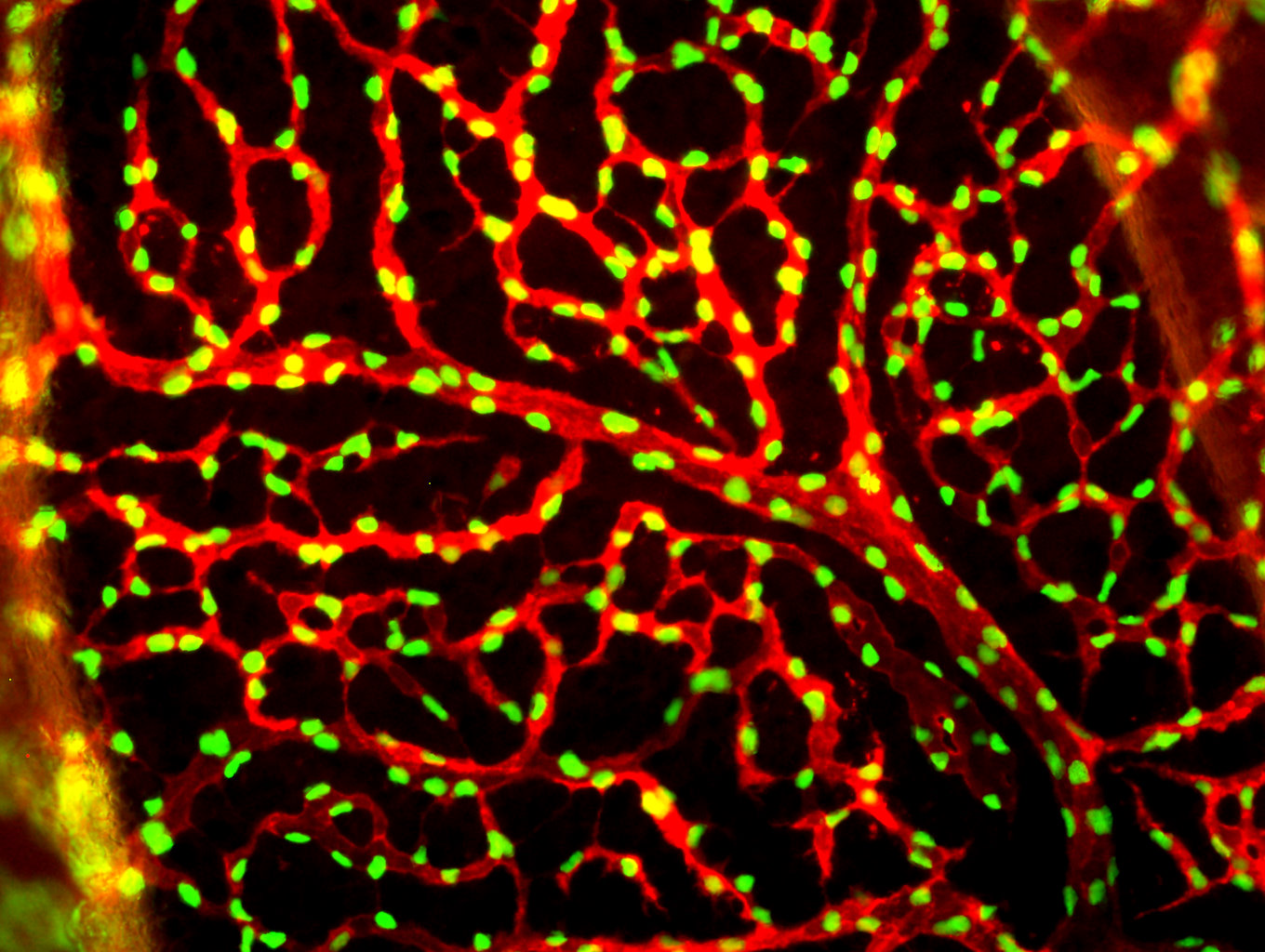
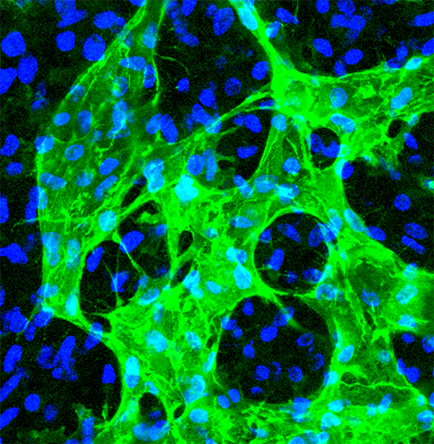
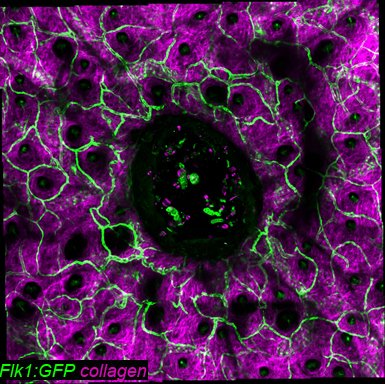
These movies show processes of blood vessel formation. Wild-type or mutant embryonic stem cell-derived vessels form over a one-week period in a culture dish - the vessels have hollow centers that sometimes contain blood cells, and they form above a layer of endoderm. We inserted GFP-transgenes linked to a vascular specific promoter, so the movies highlight development of blood vessels and their behavior.

Projection #1. This is a projection of a z-stack series of PECAM-stained vessels. It clearly shows the lumen or opening in the blood vessel (Lena Randhawa, Rylova et al., 2008).

Movie #1. The movie shown above illustrates sprouting and fusion in a developing blood vessel. Wild-type embryonic stem cell-derived vessels were labeled with GFP that was cytoplasmic. The movie covers about 3-4 hours of time, with one image/minute acquisition. The beginning of the sequence shows an endothelial cell division at the base of the sprout, then the formation of two new sprouts that fuse by the end of the sequence (Joe Kearney, see Kearney et al, Blood 2004).

Movie #2. The movie shown above illustrates the orientation of cell division in a developing blood vessel. Wild-type embryonic stem cell-derived vessels express H2B-GFP that binds nuclear DNA. The movie covers about 3-4 hours of time, with one image/minute acquisition. The sequence shows an endothelial cell division in which the division plane was perpendicular to the main vessel axis - this is normal, and in certain mutants this orientation is disrupted (Gefei Zeng, see Zeng et al, Blood 2007).


Movie #3. The movie shown above illustrates both morphogenesis and cell divisions in a developing blood vessel. Wild-type embryonic stem cell-derived vessels express H2B-GFP that binds nuclear DNA, and cytoplasmic dsRed. The movie covers about 5 hours of time, with one image/minute acquisition. The sequence shows an endothelial cell division and endothelial cell movements (Gefei Zeng, unpublished).

Movie #4. The movie shown above illustrates wild-type sprout formation. Vessels express cytoplasmic GFP. The movie covers about 4 hours, with one image/minute acquisition. The sequence shows the sprout initiate, then move away from its parent vessel at a consistent rate and angle (Chappell et al, 2009).

Movie #5. The movie shown above illustrates aberrant sprout formation in flt-1 mutant vessels. Vessels express cytoplasmic GFP. The movie covers about 4 hours, with one image/minute acquisition. The sequence shows the sprout initiate, then move but without a strong trajectory, and towards the end it seems to fold back towards the parent vessel (Chappell et al, 2009).

Return to Bautch Homepage